My fascination with North American French

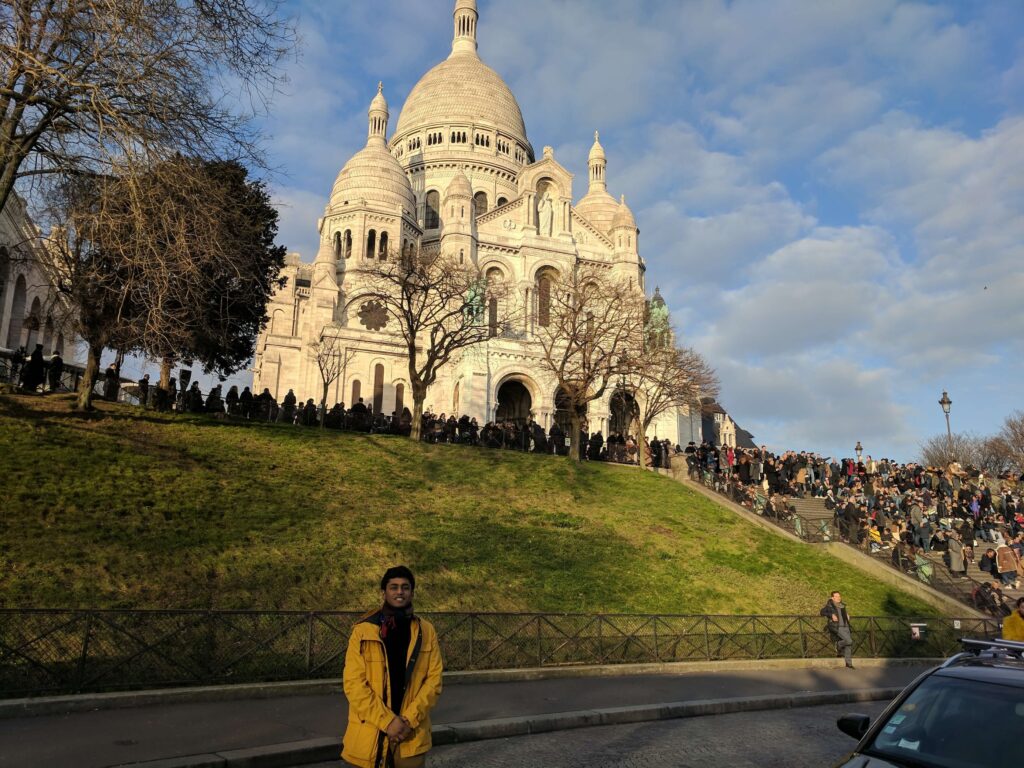
In the winter of 2018, I studied abroad in Paris, France for 6 weeks as part of the CIEE Open Campus Program. It allowed you to live in 3 different cities over the course of a semester, with 6 weeks in each. I studied in Paris, Madrid and Berlin.

When I chose my arrangement of cities, it was actually Madrid and Berlin that I really wanted to go to. Madrid, because it was the only Spanish speaking city, and I had been studying Spanish in school at that point and wanted to practice. Berlin was because I was interested in Cold War and WW2 history (the former was mostly from playing Call of Duty).

Back on my grind

This is about – you guessed it – the LSAT. I just got back to New York. Here’s the progress I’ve made:

  • Did the logic games section of the LSAT PrepTest 72
    • Tried doing a blind review (where you go back and re-do questions you didn’t get to / weren’t confident on during the timed section and review them) but I circled a lot of the answers and didn’t feel like going back through them all. I checked my results and got 11/23 on the timed section (i.e., whatever I completed under 35 minutes). I did most of three games, but didn’t get to the fourth one

Organization is key (LSAT)

Progress so far

  • Reviewed my worst set of logic games on the practice LSAT (4/6 wrong)
    • Observations: look for inferences in the set ups and questions
    • Organize well so that you can use work from previous questions on other questions in the same set
  • Purchased 7Sage and LSAT Premium

Plans

  • I’m planning on taking a practice test on 8/30 and 9/6
  • I need to review two other games by 8/30
  • I need to do one logic games section by 5pm on 8/30 (I picked LSAT PrepTest 72)
    • Stretch goal: two logic games sections (with 7sage reviews), and one RC and LR section by 8/30

How I’m feeling

I wish I had given myself more time to study and had started earlier. According to Toggl, I’ve done around 3 hours of study so far. That’s not really enough. If I can hit 20 hours by test day, I think that would be fine. I could also just not study that much and then be fine with whatever score I get – the admission fee is already paid for anyway.

Thinking through trip planning, part 2

In my previous post, I narrowed down my trip options to two itineraries: one was 10 days to London, and 5 days in Spain. Another one would be 10 day sin London, and 11 days in Spain.

The decision between both itineraries rests on whether I want to visit two Spanish regions (the Basque Country and Andalusia) or stick to one region. Another consideration is if I want to spend a full 10 days in London, or if I can shorten that time and travel elsewhere.

To figure this out, I started binge watching some travel videos. Here are some of them:

Published
Categorized as travel

Thinking through trip planning, part 1

I’m planning a trip to Europe for late September / early October. When I plan trips, I usually just try to book flights and lodging ahead of time, and plan daily activities much closer to the actual trip. Most of the time, I have a loose idea of what I want to do (and that usually takes up less than a day), and then just walk around and let serendipity take care of the rest.

However, earlier trips I’ve planned have been easier than planning this Europe trip. With other trips, I usually only have 7 – 10 days to travel because of how much PTO I can take. In that amount of time, I usually stick to 1 city, with some day or overnight trips, or 2 locations that are close by. Anything more feels more rushed.

I don’t have that same constraint with this trip, since I’m not working and thus don’t need to be back on a particular day. It’s also easier to do multiple cities on trips to Europe. You can generally hit a new city every 3 – 5 days since they’re so close together.

Besides London, there’s no other place that’s “on my bucket list” so to speak, so I can’t use that to narrow down my options. With the relative lack of constraints, there are hundreds of different itineraries that I could build.

I’ve researched travel destinations and recommendations for where to go, but I haven’t seen many people sit down and write out their thought process for how they arrived at a particular travel arrangement. I thought it would be fun to do so, and I’m hoping that other people can benefit from seeing my decision process explicitly laid out.
Published
Categorized as travel

RRR Thoughts

I just watched RRR, the Indian epic anti-colonial film that’s now the third highest grossing film in India, and is receiving critical acclaim and attention in the west. (8/18/22 Edit: The movie is also receiving a fair bit of criticism for promoting casteism and Hinduatva)

Indian cinema in the west is usually associated with Hindi-language Bollywood, and tends to ignore regional cinema. RRR is a Telugu language film, and thus is separate from Hindi language Bollywood. Telugu also happens to be the language that my family speaks. It’s directed by S. S. Rajamouli, who has been successful in producing pan-Indian films that are released in multiple languages. Baahubali was another one of his high grossing Telugu films.

A Definition of Love, from bell hooks (and MLK)

Martin Luther King, Jr. San Francisco June 30 1964
Martin Luther King, Jr. San Francisco June 30 1964” by geoconklin2001 is marked with CC BY-NC-ND 2.0.

I picked up all about love: new visions by bell hooks from McNally Jackson in Nolita last weekend. I bought it impulsively, but had known about hooks for a while.

I’m only about 10 pages in, but one passage that sticks with me is one in which hooks defines love. To clarify, it’s not her definition, it’s one she found in psychiatrist M. Scott Peck’s 1978 book The Road Less Traveled. He defines love as “the will to extend one’s self for the purpose of nurturing one’s own or another’s spiritual growth…Love is as love does. Love is an act of will-namely, both an intention and an action. Will also implies choice. We do not have to love. We choose to love.”

NYC Subway Links

File:MTA NYC Subway 1 train leaving 125th St.jpg” by Mtattrain is marked with CC BY-SA 4.0.

I recently moved to New York City, and regularly take the subway to get around. I’ve since gotten more interested in various things about the subway, and have done a little bit of reading about it. Here are some articles I’ve read over the past few weeks that I found interesting:

  • Subway system decline: This 2017 article from the Atlantic gives a good overview on the decline of the NYC subway. The subway has gotten better since then (thanks partially to ‘Train Daddy’ Andy Byford, who shows up in a different article), but many of the issues still stand. Briefly, the decline can be traced to the age of the system (it’s so old the MTA has to rebuild certain parts because they can’t be purchased), overcrowding (the subway now has nearly as many riders as its peak in 1946), lack of political will for preventative maintenance, and mismanagement of funds.
Published
Categorized as NYC

Telugu Pronunciation – Consonants

Don’t want to read? Watch this video instead!

Today, I’ll outline sounds in Telugu that are different from their English counterparts, or don’t exist in English. We’ll need to learn them in order to pronounce Telugu properly, hear distinctions between certain words, and have a good accent. I’ll focus on consonants for this post. I’ll begin by just going over the sounds, without focusing on the more technical linguistics behind it. If you’re curious to learn more, I’ve included it at the bottom of this post.

Detroit – Hamtramck Assembly

The Dodge Main, or Chrysler Hamtramck Assembly Plant, as it stood in 1965. Image from the Detroit Historical Society.

In 1980, General Motors convinced the cities of Detroit and Hamtramck, Michigan to use a newly passed eminent domain law to demolish 1,500 homes, 144 businesses, and 16 churches to build a new auto plant on the Detroit – Hamtramck Border.

At the time, Detroit was in decline, losing population and businesses to the suburbs. Detroit, and its Mayor Coleman Young, wanted to attract new businesses to the struggling city, and agreed. Despite protests, legal challenges, and a visit by Ralph Nader, the Detroit neighborhood of Poletown was demolished and its 4,200 residents relocated (CityLab).